
Provenance:
Dana Harbaugh
September 5, 2026
Complete Provenance and Builder Bio
Origin, conception, and authorization
Original-owner motorcycle: Based on a new 2009 Harley-Davidson Cross Bones purchased by Dana F. Harbaugh in Las Vegas, establishing a clean ownership chain from the motorcycle’s beginning.Conceived as a historical artifact, not merely a custom motorcycle: Harbaugh conceived the project as a “Rolling History Lesson” commemorating the December 7, 1941 attack on Pearl Harbor and the Americans directly affected by it.Project initiated in 2008: The custom historical build was commissioned in Las Vegas beginning in approximately October 2008.John W. Finn authorization: Before placing Finn’s image, Medal of Honor, citation, or story on the motorcycle, Harbaugh personally met with Medal of Honor recipient John William Finn at Finn’s California ranch and obtained his approval for the project.Direct relationship with the historical subject: Finn was therefore not simply depicted posthumously or without involvement; he knew about the motorcycle while it was being created and personally participated in its history.Finn’s connection to motorcycles: The association was especially appropriate because Finn himself had been a lifelong motorcyclist, documented in photographs of John and Alice Finn riding motorcycles.

Historical research and artistic creation
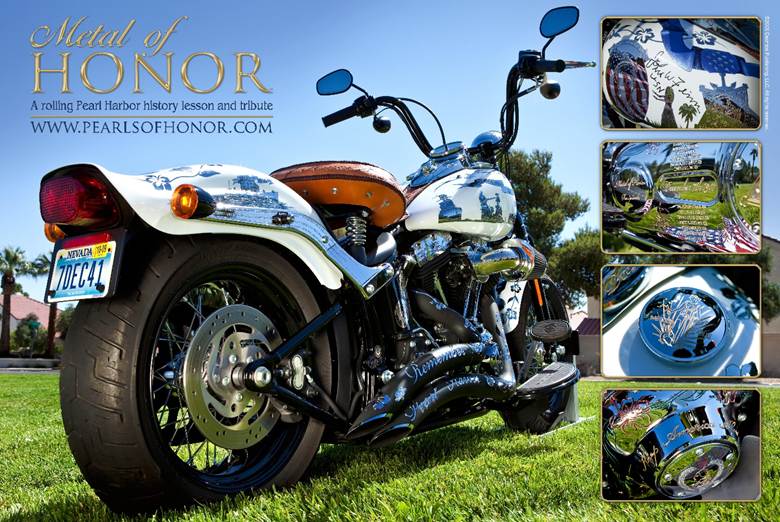
Approximately nine-month design and engraving process: The motorcycle developed through an extended research, design, engraving, finishing and reconstruction process rather than a conventional cosmetic customization.Designed by Dana F. Harbaugh: Harbaugh developed the historical concept, selected the subject matter and determined the narrative organization of the motorcycle.Master engraving by Sandi Steiner / Chrome Fusion: The major metal components were extensively hand engraved in Las Vegas.More than 120 individual historical elements: The motorcycle contains more than 120 engraved images, facts, figures, names, symbols and other historical references relating to Pearl Harbor.USS Arizona narrative: The right side of the fuel tank depicts USS Arizona (BB-39) through multiple stages of its history—before the attack, destroyed at Pearl Harbor and represented by the USS Arizona Memorial.Arizona casualty record: The tank incorporates the ship’s designation and the loss of 1,177 men, embedding one of Pearl Harbor’s central historical facts directly into the artwork.John W. Finn narrative: The opposite side of the tank is devoted to Finn, one of the first American heroes of the attack and recipient of the Medal of Honor.Source imagery connected directly to Finn: Harbaugh photographed Finn’s actual Medal of Honor for use in developing the motorcycle artwork.Finn Medal of Honor citation incorporated into the artwork: The motorcycle does more than depict Finn; it incorporates the documentary story explaining why he received the nation’s highest military decoration.WWII Victory Medal imagery: The gas cap incorporates imagery derived from the World War II Victory Medal.Hibiscus imagery: Hawaiian floral elements visually connect the motorcycle’s historical narrative to Pearl Harbor and Hawaii.Engraving integrated into the motorcycle itself: The historical content isn’t a removable graphic package. It is physically worked into major metal components of the machine.

Craftsmanship and physical construction
Chrome-before-paint process: Major body components were chromed before the engraved areas were masked and the remaining surfaces painted, allowing polished engraving to emerge through the finished bodywork.Pearl White custom finish: The motorcycle received its distinctive Pearl White finish with subtle blue flake and multiple clear coats by Purcell’z Custom’z of Las Vegas.Custom hand-tooled saddle: Bad Ass Seats of Las Vegas created the motorcycle’s custom leather saddle.Final rebuilding involved recognized custom-motorcycle craftsmen: The project ultimately incorporated work associated with established figures/businesses in the American custom-motorcycle community.Arlen Ness connection: The final reconstruction involved Arlen Ness Motorcycles, adding a separate custom-motorcycle provenance dimension beyond the Pearl Harbor story.One-of-one work: The motorcycle was conceived and executed as a singular historical-art project rather than a production edition or commemorative series.
John W. Finn’s direct physical involvement
Finn personally inspected the completed motorcycle: After completion, the motorcycle was brought to Finn’s ranch, where he examined the finished tribute.Finn personally autographed the motorcycle: Finn signed the motorcycle’s fuel tank.The autograph remains part of the motorcycle: Finn’s signature is therefore not merely accompanying memorabilia; it became part of the physical artifact.Finn’s signing was photographed/filmed: The act of signing was documented, providing unusually strong evidence connecting the autograph, the man and the motorcycle.Creator + subject provenance: The motorcycle consequently has documentary evidence connecting its designer, craftsmen and principal Medal of Honor subject to the same physical object.

Public exhibition and historical use
Red Rock Harley-Davidson: The completed motorcycle was publicly displayed at the Las Vegas dealership associated with important stages of its history.Veterans Museum and Memorial Center, San Diego: The motorcycle was displayed at the former Naval Hospital chapel in Balboa Park, connecting it with San Diego’s military and veteran community.Nellis Air Force Base: The motorcycle appeared at an event at the Nellis AFB Officers’ Club.La Posta Diner: The motorcycle participated in events associated with John Finn and the veteran/Medal of Honor community.Harley-Davidson Museum, Milwaukee: The motorcycle was displayed in the lobby of the Harley-Davidson Museum during Veterans Day week in 2010.Harley-Davidson institutional connection: Its history therefore includes exhibition within Harley-Davidson’s own museum rather than solely at independent motorcycle shows.Harley-Davidson Kansas City plant: The motorcycle’s event history also includes the Harley-Davidson manufacturing environment in Kansas City.Association of Aviation Ordnancemen: The motorcycle appeared in connection with the AO community, particularly meaningful because Finn was himself an Aviation Ordnanceman.Numerous veteran and military events: The motorcycle accumulated a history of appearances connected to Pearl Harbor, Medal of Honor recipients, veterans and military organizations.

John W. Finn funeral provenance
Finn died in 2010 at age 100.Finn family requested the motorcycle’s participation in his funeral: This transformed its relationship with Finn from commemorative artwork into an artifact involved in the final public remembrance of the man it depicts.Lead escort motorcycle: Metal of Honor served as a lead escort motorcycle in John Finn’s funeral procession.Exceptional closed-loop provenance: Finn approved the project, saw the completed motorcycle, personally signed it, and his family subsequently selected it to participate prominently in his funeral.That sequence is arguably the single strongest provenance chain associated with the motorcycle.
Photographic and documentary provenance
Extensive construction photography: Major stages of the motorcycle’s creation were photographed.Original artwork/research trail: The development process includes source material connecting historical photographs, Medal of Honor material and Pearl Harbor research to the finished engravings.Finn authorization documentation: Material exists documenting Harbaugh’s interaction with Finn before completion of the project.Finn inspection photographs: Finn’s examination of the completed motorcycle was photographed.Finn autograph documentation: His signing of the fuel tank was recorded photographically and on video.Event photography: Harbaugh photographed the motorcycle at nearly every major event in which it participated.Funeral documentation: Its participation in Finn’s funeral procession is supported by photographic/event evidence.Museum exhibition documentation: Its Harley-Davidson Museum appearance can be incorporated into the documentary provenance package.Contemporaneous rather than reconstructed provenance: Much of the evidence was created while the events were occurring rather than assembled years later solely for an auction.

Dana Harbaugh / Pearl Harbor documentary connection
Harbaugh’s Pearl Harbor involvement predates the motorcycle: The project emerged from years of interaction with Pearl Harbor survivors rather than from a later decision to build a themed collectible.Pearl Harbor 60th Anniversary, 2001: Harbaugh attended the 60th anniversary observances at Pearl Harbor with more than 50 Pearl Harbor Survivors Association members.Post-9/11 historical convergence: Those ceremonies occurred less than three months after September 11, 2001.New York first responders at Pearl Harbor: Firefighters, police officers and other first responders traveled from New York to Hawaii to participate in the commemoration.Harbaugh photographed those events: His original photography from that period became part of the broader historical experience that ultimately influenced the creation of the motorcycle.Survivor relationships: The motorcycle therefore arose from direct personal interaction with members of the generation whose experiences it commemorates.
Operational life of the motorcycle
Not built as a static trailer queen: Harbaugh actually rode Metal of Honor extensively.Approximately 15,000 miles accumulated: Its mileage reflects years of actual use as a functioning memorial motorcycle.Miles become part of the story: The motorcycle traveled to exhibitions, veteran gatherings, Harley-Davidson venues and commemorative events rather than existing solely as display art.Continuity of custody: Harbaugh has remained the motorcycle’s owner throughout its historical life, avoiding a fragmented sequence of intermediate owners and uncertain custody.Creator ownership through the provenance-building period: The individual who conceived the motorcycle also retained it while its major historical associations accumulated.
Publication and public-record provenance
Pearls of Honor project: The motorcycle forms part of Harbaugh’s larger effort to document Pearl Harbor survivors and their stories.PearlsOfHonor.com: A dedicated online archive now preserves the motorcycle’s build history, events, photographs and supporting provenance.“The Build” series: Detailed articles document its conception, engraving, painting and reconstruction.“The Events” series: The developing series documents the motorcycle’s public appearances and interactions with historically significant people and institutions.Original photographs published alongside narrative accounts: This gives researchers and prospective collectors the ability to compare claims against visual evidence.Video documentation: Relevant video further strengthens the evidentiary record surrounding Finn and the motorcycle.Long-form provenance rather than auction-only description: The historical record substantially exceeds what can fit into a normal auction catalog entry.
Current Mecum provenance
Accepted for Mecum’s 2027 Las Vegas motorcycle auction.Final auction contract executed: The finalized Mecum agreement was DocuSigned on September 1, 2026.Reserve established: The motorcycle is being offered subject to an agreed reserve rather than simply entered as an unprotected novelty lot.Confirmed auction date: Saturday, February 6, 2027.Mecum listing constructed: The catalog presentation currently includes approximately 45 photographs plus its overview and Highlights material.Major provenance incorporated into Mecum Highlights: These include the one-of-one character, Pearl Harbor theme, John Finn autograph, USS Arizona imagery, Finn funeral escort and Harley-Davidson Museum exhibition.Planned Las Vegas return: Transportation arrangements call for the motorcycle to return to Las Vegas ahead of the auction.Red Rock Harley-Davidson display strategy: The planned pre-auction display effectively brings the motorcycle back to the city and dealership environment closely associated with its creation.85th anniversary timing: The marketing and exhibition period overlaps the 85th anniversary of Pearl Harbor on December 7, 2026, giving the sale unusual historical timing.

Material expected to accompany the motorcycle
Extensive high-resolution photographic archive of approximately 10,000 photographs and selected essays..Build photographs.Historical-source photographs used in developing the artwork.John Finn photographs.Finn motorcycle inspection photographs.Finn autograph/signing documentation.Finn funeral-procession documentation.Exhibition photographs.Harley-Davidson Museum documentation.Event photographs.Relevant video documentation.Published historical narratives.Build history and craftsman information.Copies of appropriate correspondence and supporting records.Digital provenance archive Documentation tying individual engraved elements to the historical events and people represented.A structured provenance package capable of remaining with the motorcycle after transfer of ownership.
News media coverage:
Las Vegas Review Journal: https://reviewjournal.newsbank.com/doc/news/133675E7181EDDA0?=&pub%255B0%255D=WVLB&page=593&pdate=2010-11-09
San Diego Union Tribune: https://www.sandiegouniontribune.com/2010/07/23/a-rolling-memorial-for-john-finn/#
Media Milwaukee: https://mediamilwaukee.com/news/metal/
Twin Cities Pioneer Press: https://www.twincities.com/2010/10/24/harley-davidson-museum-to-pay-tribute-to-vets/
Cleveland Plain Dealer: https://www.cleveland.com/profiles-of-service/2014/05/desert_storm_navy_vet_dana_har.html
Builder Bio
The Builder
Dana F. Harbaugh
Creator, Designer and Original Owner of Metal of Honor

Metal of Honor did not begin as an attempt to build an expensive custom motorcycle.
It began with history.
Dana F. Harbaugh conceived Metal of Honor as a “Rolling History Lesson”—a one-of-one Harley-Davidson intended to preserve in steel, chrome, engraving and imagery the story of the attack on Pearl Harbor and some of the Americans who lived through it.
The motorcycle reflects Harbaugh’s own unusual intersection with Naval aviation, combat service, Pearl Harbor history, photography, veterans and Medal of Honor recipient John William Finn.
A Naval Aviation Family
Harbaugh grew up in La Jolla, California, the youngest of five sons in a Navy family.
His father, Commander Paul Max Harbaugh, USNR, served in Naval aviation from World War II through the early Vietnam and was the senior-most Landing Signal Officer in the US Navy. By 1962, Paul Harbaugh had served aboard 33 aircraft carriers and was serving as LSO Training Officer for Naval Air Force, Pacific Fleet.

Dana’s parents, Paul and Dorothy Harbaugh
That Naval aviation heritage became part of Dana Harbaugh’s own life.

S-3 Viking SENSO, AW2 Dana F. Harbaugh (callsign: Hardball). Photograph taken aboard Naval Air Station North Island, San Diego, CA in 1991
Harbaugh entered the United States Navy in 1987 and became an Aviation Anti-Submarine Warfare Operator (AW2) Naval Aircrewman flying as an S-3 Viking Sensor Operator (SENSO). Assigned to VS-38, the “Fighting Red Griffins,” Carrier Air Wing Two and USS Ranger (CV-61), he flew operational missions throughout the Western Pacific, Indian Ocean and Persian Gulf.
His deployments included Operations Earnest Will, Desert Shield and Desert Storm.
During his years flying aboard Ranger, Harbaugh accumulated approximately 275 S-3 Viking missions and 233 arrested carrier landings, including 115 at night.
During Operation Desert Storm he flew 42 consecutive night combat missions.
Among his decorations were an Air Medal with Combat “V” and a Navy Commendation Medal with Combat “V,” the latter associated with a February 27, 1991, Armed Scout reconnaissance mission during the final hours of the Gulf War.
The significance of military history was therefore never entirely academic to Harbaugh. He had lived a small piece of it himself.

Dana’s photo essay book, Pearls of Honor: Their Duty to Remember
Pearl Harbor
A decade after the Gulf War, another experience would eventually help inspire Metal of Honor.
In December 2001, Harbaugh traveled to Hawaii with the San Diego chapter of the Pearl Harbor Survivors Association for the 60th anniversary of the attack on Pearl Harbor.
The timing was extraordinary.
America was less than three months removed from the terrorist attacks of September 11, 2001. Hundreds of Pearl Harbor survivors were present during the commemorations, along with firefighters, police officers and other first responders who had traveled from New York to Pearl Harbor following the attacks on their own city.
Harbaugh photographed the people and events surrounding that anniversary.
For him, the experience brought together two generations separated by 60 years: Americans who had witnessed the attack that brought the United States into World War II and Americans who had just experienced another surprise attack on American soil.
Those photographs—and, more importantly, the people behind them—remained with him.
Pearl Harbor ceased to be simply a date in a history book.
It had faces.

John William Finn
One of those faces was John William Finn.
Finn was a Navy Aviation Ordnanceman stationed at Naval Air Station Kaneohe Bay when Japanese aircraft attacked Hawaii on December 7, 1941.
His actions that morning ultimately resulted in his receiving the Medal of Honor.
Decades later, Harbaugh came to know Finn personally.
That relationship became fundamental to Metal of Honor.
When Harbaugh began developing the concept for a motorcycle that would tell the story of Pearl Harbor, he knew that Finn’s story belonged on it. He also believed that he had no right to place Finn’s likeness and Medal of Honor story on a motorcycle without first asking the man himself.
Before the work proceeded, Harbaugh met with Finn at his California ranch and discussed the project with him.
Finn approved.
That approval established a relationship between the historical subject and the physical artifact before the motorcycle was completed.

Building a Rolling History Lesson
Harbaugh purchased the Harley-Davidson Cross Bones new and remained its original owner throughout the motorcycle’s development and historical life.
Beginning in Las Vegas in 2008, he conceived, researched, designed and commissioned what became Metal of Honor.
Harbaugh was the project’s creator and designer, but he did not pretend to be its engraver, painter, leatherworker or fabricator.
Instead, specialized craftsmen transformed his historical concept into the finished motorcycle.

Master engraver Sandi Steiner of Chrome Fusion undertook the extensive engraving work. Purcell’z Custom’z created the distinctive Pearl White finish with subtle blue flake. Bad Ass Seats produced its custom leather saddle, while other craftsmen contributed to the motorcycle’s fabrication and final assembly.
The design and engraving process alone extended over approximately nine months.
More than 120 individual facts, figures, images, symbols and historical references were ultimately incorporated into the motorcycle.
The right side of the fuel tank tells the story of USS Arizona (BB-39), depicting the battleship before the attack, after its destruction and through the memorial that now stands above the wreck.
The opposite side honors John W. Finn.
Harbaugh personally photographed Finn’s Medal of Honor as part of the source material used in creating the motorcycle. Finn’s image, Medal and citation became part of a larger engraved narrative intended to encourage someone encountering the motorcycle to stop, look closely and ask:
What happened here?
That was the purpose of the project.
Not simply to decorate a Harley-Davidson.
To make people curious about history.

Finn Meets the Finished Motorcycle
After Metal of Honor was completed, Harbaugh brought the motorcycle back to John Finn.
Finn inspected the finished machine and saw how his story had been incorporated into it.
Then he did something that permanently changed the motorcycle’s provenance.

John William Finn signed its fuel tank.
The moment was documented in photographs and video.
The significance goes considerably beyond possessing the autograph of a Medal of Honor recipient.
Finn had known about the project before it was built. He had authorized Harbaugh to proceed. He later saw the completed motorcycle for himself and personally signed the physical artifact bearing his image and story.
That sequence—authorization, creation, inspection and autograph—forms one of the central provenance chains of Metal of Honor.

From Artwork to Rolling History Lesson
Harbaugh never intended Metal of Honor to spend its life hidden in a private collection.
He rode it.
Over the years, the motorcycle accumulated approximately 15,000 miles while appearing at military, veterans, motorcycle and historical events.
Its history came to include appearances associated with Red Rock Harley-Davidson in Las Vegas, the Veterans Museum and Memorial Center in San Diego, Nellis Air Force Base, the Association of Aviation Ordnancemen, Harley-Davidson facilities and numerous veteran gatherings.
During Veterans Day week in 2010, Metal of Honor was displayed in the lobby of the Harley-Davidson Museum in Milwaukee.
But perhaps its most consequential journey involved John Finn one final time.
After Finn’s death in 2010 at the age of 100, his family requested that Metal of Honor participate in his funeral procession.
The motorcycle served as a lead escort.
The machine that Finn had authorized, inspected and personally signed now helped accompany him on his final journey.
Its relationship with Finn had come full circle:
Authorization.
Creation.
Inspection.
Signature.
Funeral escort.

Stewardship
Harbaugh remained the owner and custodian of Metal of Honor throughout this history.
That continuity matters.
There is no succession of unknown owners separating the motorcycle today from the circumstances of its creation. The person who conceived the project remained with the motorcycle while its historical associations accumulated.
He also documented that history.
Thousands of miles, construction stages, exhibitions, veterans’ events, encounters with Pearl Harbor survivors, John Finn’s involvement and the motorcycle’s subsequent life produced an extensive archive of photographs, video, correspondence and written records.
Harbaugh later began organizing and publishing that material through the Pearls of Honor project so that the story behind the motorcycle would not depend solely upon memory or auction-catalog descriptions.
The objective is preservation: wherever possible, a claim about the motorcycle should be accompanied by evidence allowing future owners, historians and collectors to examine the underlying record themselves.
The Builder’s Role
Calling Dana Harbaugh the “builder” of Metal of Honor requires an important distinction.
He was not the individual craftsman responsible for every physical operation performed on the motorcycle.
He was its originator, historical researcher, designer, commissioner, project director, original owner and long-term custodian.
The engravers engraved.
The painters painted.
The leatherworkers worked the leather.
The fabricators and mechanics performed their crafts.
Harbaugh determined what the motorcycle was supposed to say.
That distinction is important because Metal of Honor was never intended merely as an exercise in motorcycle customization. Its physical craftsmanship served a larger historical narrative.
The motorcycle was the medium.
Pearl Harbor was the subject.

Metal of Honor
Nearly two decades after the project began, Metal of Honor is preparing for another change in its history.
The motorcycle is scheduled to be offered by Mecum Auctions in Las Vegas on February 6, 2027.
For Harbaugh, its sale represents something different from simply selling a motorcycle.
He has been its only owner.
He conceived it, commissioned it, watched craftsmen transform the idea into metal and paint, brought it to John Finn, watched Finn sign it, rode it thousands of miles, exhibited it, escorted Finn’s funeral procession with it, photographed its travels and preserved the documentary record surrounding it.
Eventually, however, stewardship of a historical object must pass from one person to another.
That is the final role Harbaugh intends to perform for Metal of Honor: to preserve its story well enough that when the motorcycle leaves his possession, its history does not leave with him.
The next owner will acquire the motorcycle.
The provenance is intended to ensure that future generations understand why it was built, who built it, who touched its history—and what it was meant to remember.
